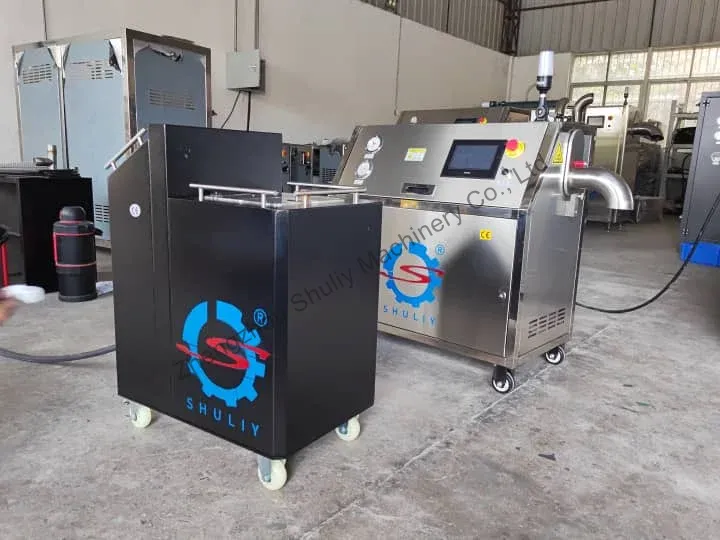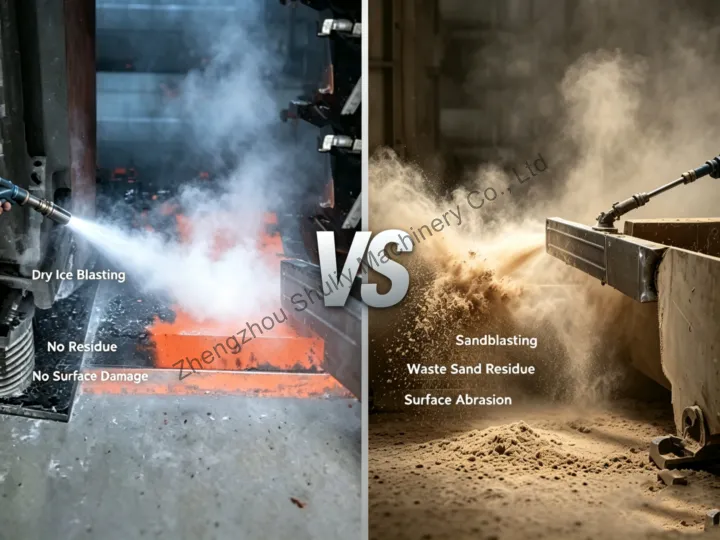
If you manage a maintenance shop, run a mold-cleaning line, or spec equipment for a food or automotive plant, the choice between dry ice blasting and sandblasting directly affects your downtime, waste bill, and equipment life. After 14 years of building dry ice blasting machines for customers in 10+ countries, I have seen both technologies perform in real production environments.
This guide is an honest, side-by-side comparison written from a working engineer’s perspective, not a sales pitch.
Quick verdict up front: dry ice blasting wins for roughly 80% of modern industrial cleaning — in-place cleaning, food-grade equipment, electronics, moulds, engines, and anywhere a stream of spent abrasive would cause a problem. Sandblasting still holds the edge when you need to aggressively remove thick paint, heavy rust, or scale from structural steel and managing the spent media is not a concern.
Below, I break down why — and how to pick the right tool for your operation.
What Is Dry Ice Blasting?
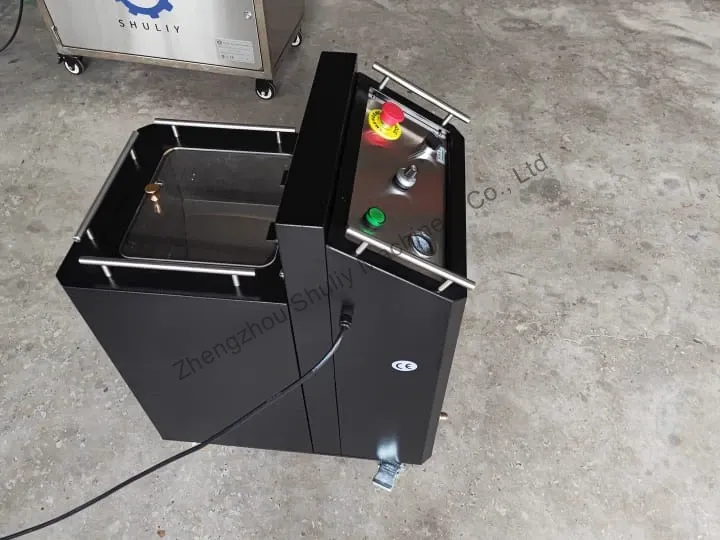
Dry ice blasting (also called CO₂ blasting or cryogenic cleaning) is a non-abrasive cleaning process. It uses recycled CO₂ in solid pellet form, accelerated through a blasting nozzle by compressed air. The pellets are made on-site or on demand by a dry ice pellet machine, typically 3 mm in diameter for cleaning work. When a pellet hits the contamination layer, three things happen at once:
- Kinetic energy — the pellet traveling at 150–300 m/s cracks the bond between the dirt and the substrate.
- Thermal shock — the −78.5 °C pellet freezes the contamination, making it brittle.
- Micro-explosion (sublimation) — the pellet flashes to gas and lifts the dirt particles off the surface.
What is left on the floor? Only the contaminant you removed. The dry ice itself has sublimated back into the atmosphere as CO₂ gas. There is no grit, no spent media, no spent solvents to dispose of. This is the main reason automotive plants, food lines, and electronics manufacturers have switched from sandblasting to dry ice blasting over the last decade.
What Is Sandblasting?
Sandblasting (or abrasive blasting) is the older of the two processes. It propels an abrasive — silica sand, glass beads, aluminum oxide, steel grit, or even crushed walnut shells — at high velocity against the surface to be cleaned. The abrasive itself is the cutting tool: it physically grinds away rust, paint, scale, and old coatings.
There are three common configurations:
- Siphon (suction) blaster — low pressure (60–80 PSI), best for light cleaning, common in small auto shops.
- Pressure blaster — high pressure (100–150 PSI), 4× faster than siphon, used in heavy industrial work.
- Wet abrasive blasting — water + abrasive mix, reduces dust, used where silica dust is a regulatory concern.
Sandblasting is effective, cheap to set up (a basic cabinet can be bought for under $500), and the right tool for one job: stripping heavy coatings off structural steel before recoating. The serious drawback is that the abrasive, the removed coating, and the substrate dust all end up in the same waste stream, which has to be collected, tested, and disposed of as industrial waste.
Dry Ice Blasting vs Sandblasting: 8 Key Differences
Here is the comparison I walk every customer through on a factory audit. These 8 dimensions decide which technology fits which job.
1. Cleaning Mechanism
Dry ice blasting is a non-contact cleaning method. The dry ice pellet sublimates on impact, so the only thing that touches the substrate is the gas. The dirt is lifted by thermal shock and micro-explosion, not by grinding.
Sandblasting is a contact grinding method. The abrasive physically abrades both the contamination and a thin layer of the substrate. This is why sandblasted steel has a characteristic matte “anchor profile” — the surface is intentionally roughened to help new paint adhere.
2. Substrate Damage
Because the CO₂ pellet sublimates instead of grinding, dry ice blasting does not damage the substrate. You can clean aluminum moulds, electrical windings, printed circuit boards, hydraulic cylinders, and soft rubber seals without changing their dimensional tolerances.
Sandblasting, by design, removes a thin layer of substrate. Run a sandblaster too long on aluminum and you pit the part. On a precision mould, you scrap the tooling. This is why mould-cleaning shops in Germany, the US, and Korea have standardized on dry ice blasting for mould work.
3. Secondary Waste
With dry ice blasting, the only waste is the contamination you removed. The dry ice is gone — it is back in the air as CO₂. With sandblasting, you generate 3 streams of waste: spent abrasive, removed coating, and substrate dust.
In the EU, US, and increasingly in the Gulf, this waste stream is regulated as industrial hazardous waste and must be disposed of through licensed contractors at $200– 800 per ton.
4. Cleaning Speed
For light-to-medium contamination (oil, release agent, light rust, food residue), dry ice blasting is 2–4× faster than sandblasting because there is no secondary clean-up step. The operator finishes the blasting pass and the job is done — no sweeping, no vacuuming, no media recovery.
For heavy material removal — 5 mm of marine encrustation, 200 μm of multilayer industrial coating, or scale on a ship hull — sandblasting is faster because it is removing material, not just contamination.
5. Equipment Disassembly
Dry ice blasting is an in-place cleaning method. Most jobs can be done without removing the equipment from the line. We have customers cleaning 40-ton injection moulding machines, 12-cylinder marine engines, and full bakery ovens without loosening a single bolt.
This is impossible with sandblasting — the abrasive gets into every crevice, every bearing, every electrical connector, so full disassembly is mandatory.
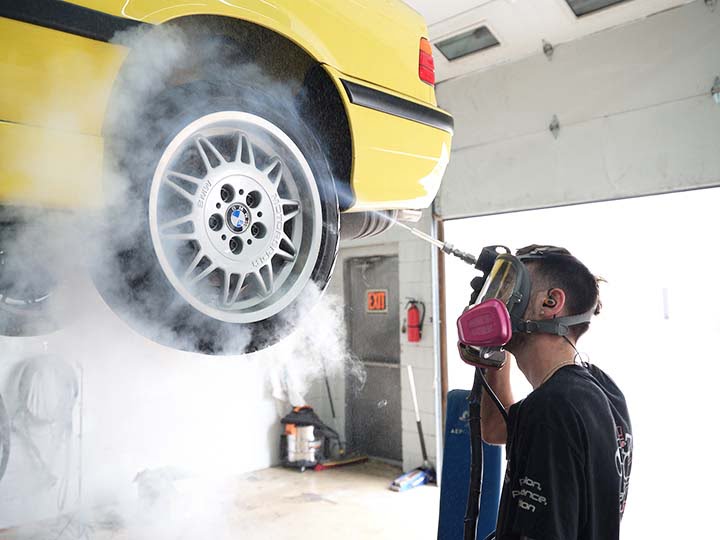
6. Safety & Operator Health
Sandblasting, especially with silica sand, generates respirable crystalline silica dust — a known cause of silicosis, lung cancer, and chronic obstructive pulmonary disease. Most developed countries now require closed-cabinet sandblasting, full Tyvek suits, and supplied-air respirators. Even with these precautions, exposure incidents still happen.
Dry ice blasting has a different risk profile. The CO₂ vapor is non-toxic but displaces oxygen in enclosed spaces, so ventilation is critical. Operators need ear protection (the equipment is loud, 90–100 dB), insulated gloves (the pellets are −78 °C), and a face shield. There is no silica, no toxic dust, no lead paint chips becoming airborne. Most operators find training easier and PPE lighter than sandblasting requires.
7. Operating Cost
Per-hour operating costs in 2026, based on a 2-operator team running a 6-hour shift in a US Gulf Coast plant:
| Cost Item | Dry Ice Blasting | Sandblasting |
| Equipment (industrial-grade) | $4,000– 9,000 | $500– 3,500 |
| Consumable (per hour) | 5– 15 (pellets made in-house) | 8– 30 (abrasive media) |
| Waste disposal (per hour) | 0– 2 | 20– 80 |
| Labor (per hour, 2 ops) | $60 | $90 (longer cycle, plus cleanup) |
| PPE & consumables | $5 | $15 |
| Total per hour | $70– 82 | $133– 219 |
Yes, the sandblasting cabinet is cheaper up front. But once you factor in the abrasive, the waste disposal, and the extra labor hours, dry ice blasting is 30–50% cheaper per job — and that is before you count the savings from not disassembling equipment.
8. Environmental Compliance
For plants operating under ISO 14001, REACH, or EPA stormwater permits, dry ice blasting is dramatically easier to permit. There is no abrasive to track into floor drains, no spent media in the dumpster, and the CO₂ released is the same CO₂ that was captured for industrial use.
Sandblasting — especially on lead-painted bridges, marine hulls, or chemical equipment — usually requires a written dust-control plan, perimeter monitoring, and licensed waste hauling.
Side-by-Side Comparison Table
This is the table I keep on my desk for quick customer conversations. Print it out and tape it to your shop wall.
| Dimension | Dry Ice Blasting | Sandblasting |
| Cleaning media | Solid CO₂ pellets (3 mm) | Silica, glass, aluminum oxide, etc. |
| Substrate contact | None (sublimation) | Direct abrasive contact |
| Substrate damage | None | Yes, by design |
| Secondary waste | None (only removed dirt) | 3 streams (media + coating + substrate) |
| In-place cleaning | Yes, no disassembly | No, full disassembly required |
| Cleaning speed (light duty) | 2–4× faster | Baseline |
| Cleaning speed (heavy removal) | Slower | 2–3× faster |
| Equipment cost | $ 4 K – 9 K industrial | $ 500– 3.5K |
| Per-hour operating cost | $ 70– 82 | $ 133– 219 |
| Disassembly labor | None | Significant |
| Operator health risk | Low (CO₂ ventilation) | High (silica, lead, dust) |
| Permitting complexity | Low | Medium to high |
| Best for | Precision, food, electronics, in-place | Heavy paint, rust, scale, steel prep |
| Worst for | Heavy material removal | Delicate substrates, food lines |
Where Each Method Shines: Application Guide
Choosing the wrong technology for the job is the most expensive mistake you can make. Here is the rule of thumb I give to my own engineers.
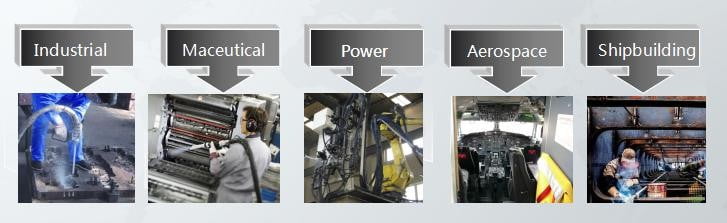
Choose dry ice blasting for…
- Cleaning injection moulds, blow moulds, and die casts without disassembly
- Food processing lines, bakery ovens, packaging equipment — no chemical residue
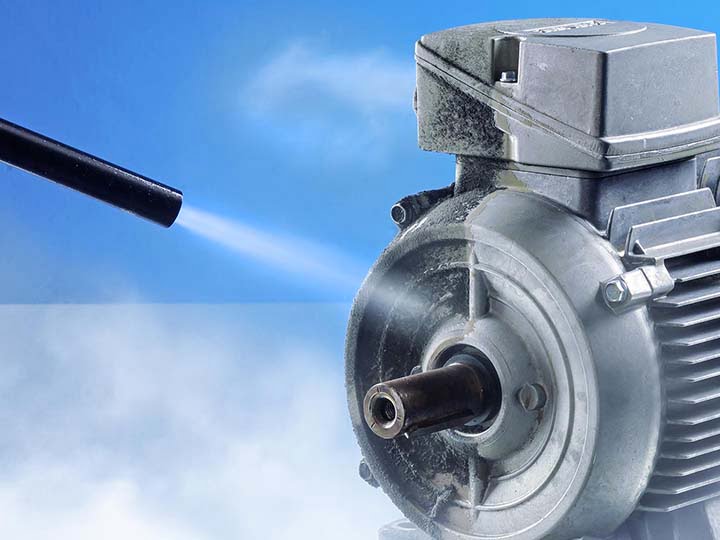
- Electric motors, generators, and wind turbines — safe on windings and insulation
- Historic restoration (stone, brick, timber) where abrasive damage is unacceptable
- Automotive engine bays, transmission housings, and EV battery housings
- Printing rollers, papermill machinery, and textile equipment
- Nuclear, pharmaceutical, and aerospace parts where any secondary waste is a regulatory problem
Choose sandblasting for…
- Removing thick multilayer industrial coatings (epoxy, polyurethane, coal tar epoxy) from structural steel
- Ship hull maintenance — removing marine growth, anti-fouling paint, and barnacles
- Bridge and infrastructure repainting projects
- Surface preparation to SSPC-SP 10 near-white metal before recoating
- Concrete profiling and decorative etching
- Large outdoor structural steel where disassembly is impossible and waste capture is feasible
How to Choose: A 4-Step Decision Guide
If you are still on the fence after the comparison table, run your job through these four questions. If 3 out of 4 point to dry ice blasting, that is almost always the right answer.
- Is the substrate delicate, food-contact, or electrical? → Dry ice blasting.
- Do you need to clean in place without disassembly? → Dry ice blasting.
- Is the contamination a thin film (oil, release agent, light rust) or a thick coating? → Thin film = dry ice; thick coating = sandblasting.
- Are you under ISO 14001, FDA, or strict environmental permitting? → Dry ice blasting.
For a deeper look at how dry ice blasting performs on specific substrates (moulds, engines, food lines, electronics), read our complete look at dry ice blasting from four perspectives and our top 10 benefits guide. Both articles include the application data we collected from real customer sites.
Pros and Cons at a Glance of Dry Ice Blasting Vs Sandblasting
Dry Ice Blasting — Pros & Cons
- Pros: No substrate damage, no secondary waste, in-place cleaning, food-safe, eco-friendly, low permitting, faster on light jobs
- Cons: Higher initial equipment cost, requires pellet supply, slower on heavy removal, CO₂ ventilation needed
Sandblasting — Pros & Cons
- Pros: Low equipment cost, very effective on thick coatings, well-understood, simple technology
- Cons: Damage substrate, generate hazardous waste, require full disassembly, silica health risk, slow on light jobs, heavy permitting
What Real Customers Are Doing in 2026
The shift is well underway in every region we ship to. A few examples from our own order book:
- Saudi Arabia (2024): An industrial maintenance contractor replaced two sandblasting crews with a fleet of SL-750 干冰喷射器s. Their waste disposal cost dropped from $4,200/month to $180/month, and the crews no longer need full Tyvek suits in the desert heat.
- Poland (2024): An automotive detailing shop swapped from a sandblasting cabinet to a dry ice blasting machine for cars. Average cleaning time per engine dropped from 90 minutes to 35 minutes, and they can now take on aluminium and magnesium parts that the sandblaster was destroying.
- Iraq (2023): An oilfield services company added dry ice blasting to clean heat exchangers and valves on-site, eliminating the disassembly step that used to take two days per unit.
Sandblasting is not going away — it is still the right tool for stripping bridge paint and ship hulls. But for the 80% of industrial cleaning done on working equipment in active factories, dry ice blasting has become the new default
Final Verdict — and How to Get Started
For most modern industrial cleaning — moulds, engines, food lines, electronics, in-place maintenance — dry ice blasting is the smarter investment in 2026. It is faster on light-to-medium jobs, gentler on your substrate, dramatically cheaper on waste, and far easier to permit.
Sandblasting still has a place for one job: stripping thick, aggressive coatings from structural steel where the substrate can take the abuse. Most modern plants end up running both technologies side by side and routing each job to whichever fits.
If you are ready to put a dry ice blasting system on your shop floor, the next step is a 20-minute consultation with our engineering team. Tell us your substrate, contamination, and production volume, and we will configure a system around your exact job — including the matching 干冰颗粒机 if you want to bring pellet production in-house.
Reach us on WhatsApp at +86 13673689272 or email info@dryice-equipment.com for a same-day response and a detailed quotation.